Beginning July 1, 2024, the minimum wage in the District of Columbia will increase from $17.00 per hour to $17.50 per hour for all workers, regardless of the size of the employer. Additionally, as of July 1, 2024, the base ... Read More
As you know, private employers with 100 or more employees and federal contractors with 50 or more employees are required to report an EEO-1 Component 1 report on an annual basis. The report includes the number of individuals employed by ... Read More
Pursuant to the state’s Statewide Education and Workforce Development Act, every South Carolina employer with ten or more employees must file the portion of the “Employer Quarterly Contribution and Wage Reports” containing their employees’ social security number, name, Standard Occupational ... Read More
Contractors and subcontractors should be aware of a new New Jersey bill, which provides that unions may file wage claim suits on behalf of their own workers and workers unaffiliated with a union, against a contractor or subcontractor at any ... Read More
OSHA recently amended its recordkeeping regulations, now requiring businesses with 100 or more employees in certain high-risk industries to electronically submit their work-related injury and illness records using Forms 300 and 301 by March 2, 2024, for the year 2023. This change aims to ... Read More
South Dakota has amended its medical cannabis law to authorize certain employer actions regarding the use of cannabis by an employee or a prospective employee. Specifically, based solely on a positive test result for cannabis metabolites, employers may take adverse employment actions ... Read More
Illinois law requires private businesses with 100 or more employees in the State of Illinois to submit an application to obtain an Equal Pay Registration Certificate (EPRC) by providing certain pay, demographic, and other data to the Illinois Department of ... Read More
OSHA has issued a new directive providing guidance to OSHA personnel concerning the agency’s policy and technical interpretations regarding the enforcement of the standard for Process Safety Management of Highly Hazardous Chemicals (“PSM standard”). The directive affects companies that are ... Read More
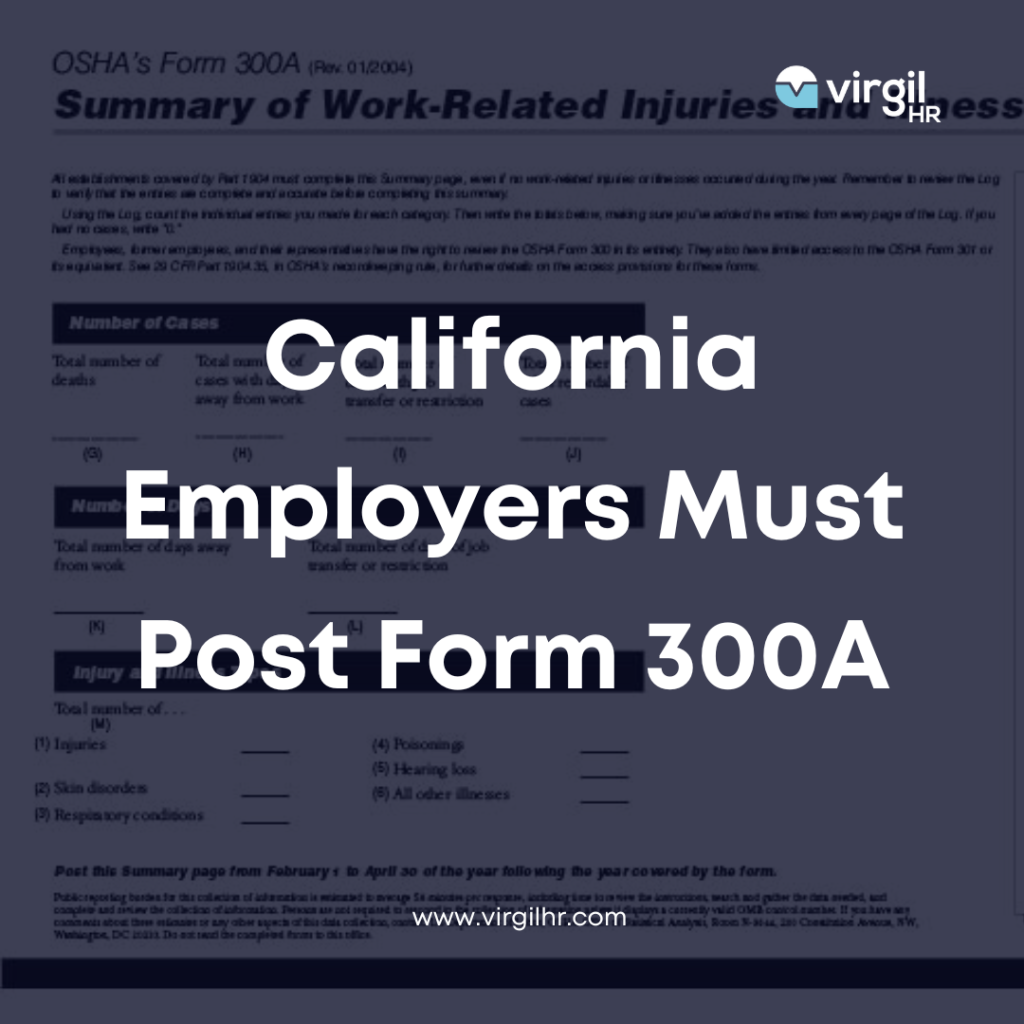
As a reminder for California employers, all employers that are required to maintain injury and illness records must post Form 300A by February 1 of the year following the year covered by the records. It must remain posted at the worksite until ... Read More
February 14, 2024 was the deadline for California employers to notify current or former employees employed after January 1, 2022, whose contracts include a noncompete agreement or clause, that the agreement or clause is void. The employee notice must be ... Read More
Under Texas Senate Bill 240, now Chapter 331 of the Texas Health and Safety Code, Texas healthcare facilities are required to establish workplace violence prevention policies and plans by September 1, 2024. This requirement underscores the state’s commitment to enhancing the safety and ... Read More
Virginia law prohibits employers from entering or attempting to enforce any noncompete agreements with “low-wage employees,” defined to include employees whose average weekly earnings are less than the average weekly wage in the state. For 2024, the average weekly wage ... Read More